1. Welcome
Most people don’t need another extreme diet, miracle supplement or “get rich in 30 days” promise. They need a calmer, clearer way to look at their life:
- How their body feels from morning to night
- How their mind handles stress and decisions
- How money and work affect their health and mood
This is what the 360° approach is about.
This short guide will help you:
- Understand the basic idea behind the 360° life model
- See how the gut–brain axis and daily habits shape your energy
- Start with three realistic habits you can test this week
- Get a transparent overview of a performance-based income path (with no guarantees or hype)
2. The 360° life model in simple words
You can imagine your life as a circle with three major layers:
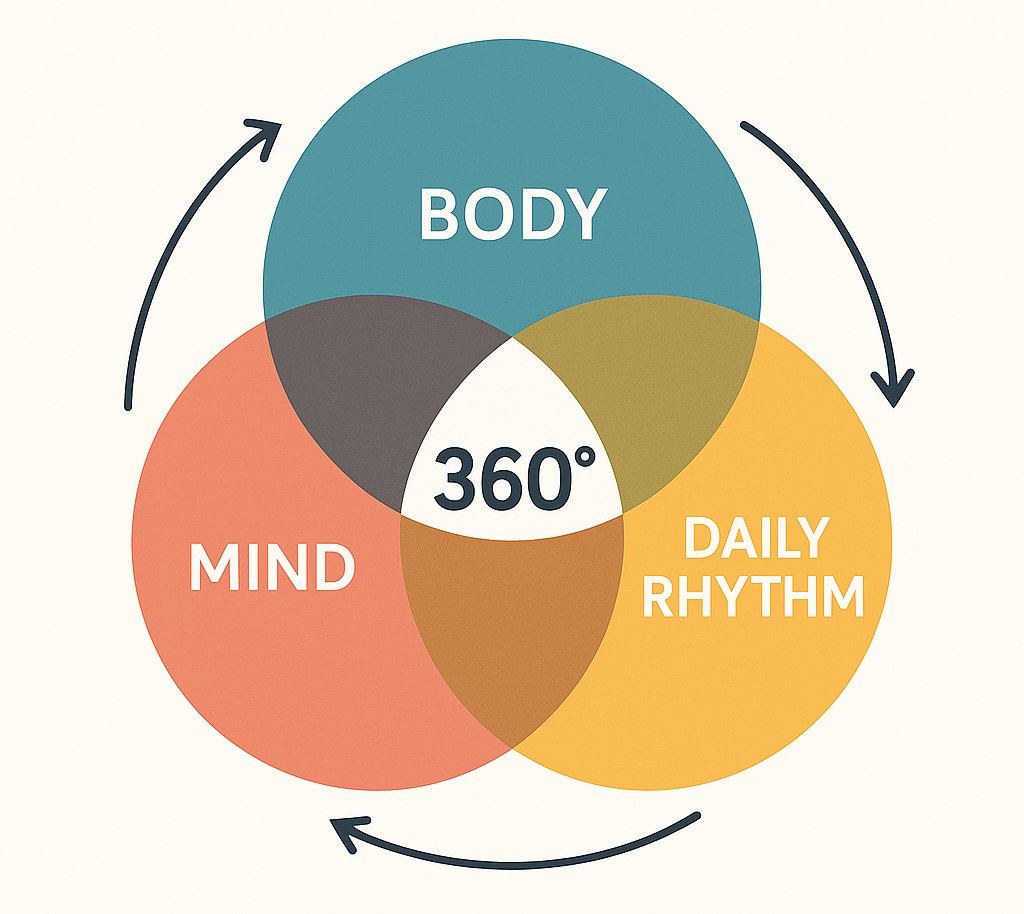
Layer 1 – Body
- Gut function and digestion
- Micronutrients (vitamins, minerals, phytonutrients)
- Movement and physical capacity
Layer 2 – Mind
- Stress responses and emotional regulation
- Focus, attention and mental clarity
- Self-talk and identity (how you see yourself)
Layer 3 – Daily rhythm & environment
- Sleep quality and timing
- Light exposure and screen habits
- Social connections and work structure
Most people try to “fix” their life by attacking one single point: only food, only supplements, only mindset or only money.
The 360° model suggests something different:
“Small changes in several key places often beat aggressive changes in just one place.”
You don’t need to be perfect. You need a realistic upgrade across body, mind and daily rhythm, step by step.
3. The gut–brain axis & your daily energy
You may have heard the phrase “gut–brain connection” or “second brain”. In simple terms, this means:
- Your gut and your brain constantly send signals to each other
- These signals influence mood, energy, sleep, stress tolerance and cravings
Some everyday examples:
- When you are very nervous and your stomach feels tight
- When you feel sleepy and unfocused after a very heavy meal
- When several days of poor sleep make you crave more sugar or junk food
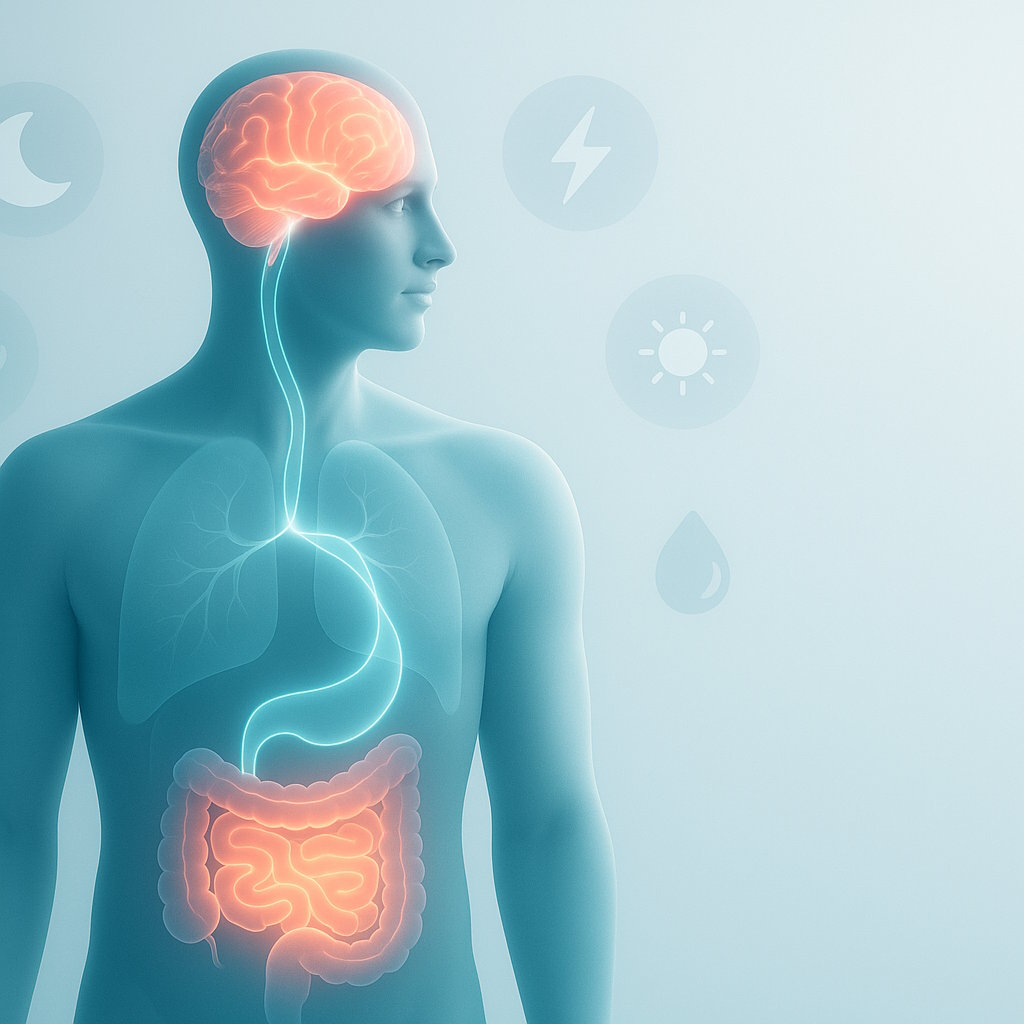
Science is still discovering new details about the gut–brain axis, but one thing is clear:
What you eat, how you sleep, how you handle stress and how your gut functions are all part of one connected system.
That’s why the 360° approach doesn’t only talk about “healthy food” in general. It also looks at:
- Fiber and plant diversity
- Hydration
- Meal timing
- Stress load and recovery
- Quality of sleep and light exposure
You don’t need to become a scientist to benefit from this. You just need to understand a few principles and apply them consistently.
4. Three realistic habits to start this week
You can’t change everything at once. So this guide focuses on three simple habits that many people can start safely, after checking with their healthcare professional if needed.
You can choose one, two or all three, depending on your current situation.

Habit 1: The “first 60 minutes” reset
Goal: Create a calmer, more stable foundation for your nervous system and energy for the rest of the day.
Basic version (for busy people):
- Within the first 60 minutes after waking:
- Drink a glass of water (plain or with a slice of lemon, if you like it and it’s suitable for you)
- Get 5–10 minutes of light exposure (natural light if possible, or at least look away from your screen near a window)
- Avoid ultra-processed sugar bombs as your very first “fuel”
Why it matters (in simple language):
- Hydration supports blood volume, circulation and brain function
- Light exposure helps your internal clock understand that it is daytime
- Starting with less sugar may help avoid extreme energy peaks and crashes
How to upgrade it later:
- Add 5–10 minutes of gentle movement (stretching, walking, mobility)
- Eat a breakfast or first meal that includes some protein and fiber (vegetables, fruit, whole foods)
Habit 2: The “20-minute walk buffer”
Goal: Use movement to help your body and mind process daily stress and support better sleep quality.
Basic version:
- On most days of the week, try to have at least:
- One 15–20 minute walk after a meal, or
- Two shorter 10-minute walks at any time
Why it matters:
- Light to moderate movement:
- Helps digestion
- Supports blood sugar regulation
- Can reduce mental tension and rumination
- Walking is free, accessible and usually safe for most people (always check with your healthcare professional if you have concerns)
How to make it more likely to happen:
- Link it to something you already do daily (after lunch, after work, after dinner)
- Walk with a friend or a good podcast, if that keeps you more consistent
- Track your steps if that motivates you, but avoid obsessing over the exact number
Habit 3: The “evening landing strip”
Goal: Help your body and mind land more smoothly into sleep, instead of crashing into the night with full speed and bright screens.
Basic version (start small):
- Choose one of these, ideally 30–60 minutes before bed:
- Reduce intense screen time (stressful news, arguments, work emails)
- Dim the lights in the room a little
- Write down 3–5 thoughts:
- One thing you are grateful for
- One thing you want to leave for tomorrow
- One simple task for the next morning
Why it matters:
- Sleep is one of the main “repair systems” for your brain and body
- Stressful content and bright screens can confuse your internal clock
- Writing a few things down tells your brain that it doesn’t need to hold everything at once
How to upgrade it later:
- Add a short breathing practice, light stretching or reading a physical book
- Try to keep a more stable sleep schedule when possible (similar sleep and wake times)
5. How health & income intersect (without hype)
Health and money are both sensitive topics. They can support each other or harm each other, depending on how they are handled.
The 360° approach looks at income with the same realism as it looks at health.

5.1 What “performance-based income” means
Performance-based income is not:
- A guaranteed salary
- A fixed interest rate
- A promise of a specific amount of money
- “Passive income” that appears without work
Instead, it usually means:
- You learn something useful (for example, a way to improve health and daily energy)
- You apply it in your own life with integrity
- You share it with people who are actively interested and give them honest expectations
- You are rewarded based on real activity and results
Some people do not earn anything, or only a symbolic amount. Others, over time and with consistent effort, may build meaningful additional income. There is no guaranteed outcome for anyone.
5.2 Healthy questions to ask yourself
Before you consider any income path connected to health, it can be helpful to ask:
- Do I genuinely care about people’s wellbeing, not only about money?
- Am I willing to say “I don’t know” or “this is not for you” when necessary?
- Can I be patient and work consistently, without expecting quick success?
- Am I ready to keep learning about health, ethics and communication?
If the answer to most of these is “yes”, a performance-based model may be an interesting path for you. If your main motivation is fast money with minimum effort, this kind of path usually leads to frustration.
6. Your 4-week 360° experiment
Instead of promising big changes, this guide invites you to run a four-week experiment in your own life.
You can use this simple structure:
Week 1 – Observation
- Start with one or two habits from this guide
- Each evening, quickly note:
- Energy level (1–10)
- Mood (1–10)
- Sleep quality (short comment)
You are not trying to be perfect. You are just collecting information.
Week 2 – Small adjustments
- Keep your basic habits
- Add one small improvement:
- Slightly better food choices during one meal per day
- A more consistent evening landing strip
- A bit more movement during the day
Week 3 – Reflection
- Look at your notes from weeks 1–2
- Ask yourself:
- Which small changes seem to help me the most?
- Which ones are too heavy or unrealistic right now?
Keep what helps. Simplify what doesn’t.
Week 4 – Decision point
By now you should have:
- A better sense of how small changes affect your energy and mood
- A clearer picture of your current limits and possibilities
You can now decide:
- Maybe you just keep the habits for your own wellbeing
- Maybe you want to go deeper and learn more about the 360° health & income path
- Maybe you realise this is not the right moment, and that is also okay
7. What happens next
If you received this guide via email, you will likely also receive:
- A short series of educational emails expanding the ideas in this guide
- Practical examples of how people apply the 360° model in real life
- A transparent overview of how a performance-based income path can work in this context
You remain in control at every step:
- You can unsubscribe at any time with one click
- You can choose to stay only for the health education part
- You can decide later if the income path is worth exploring in detail
8. Final reminder
Before you close this guide, remember:
- You don’t have to fix everything at once
- Small, realistic changes can have a real impact over time
- Health and income both respond better to honesty, patience and consistent effort than to magic promises
If this approach resonates with you, the next logical step is simple:
Choose one habit from this guide and start today or tomorrow, even if your first attempt is imperfect.
Every 360° journey starts with a small, clear step.